
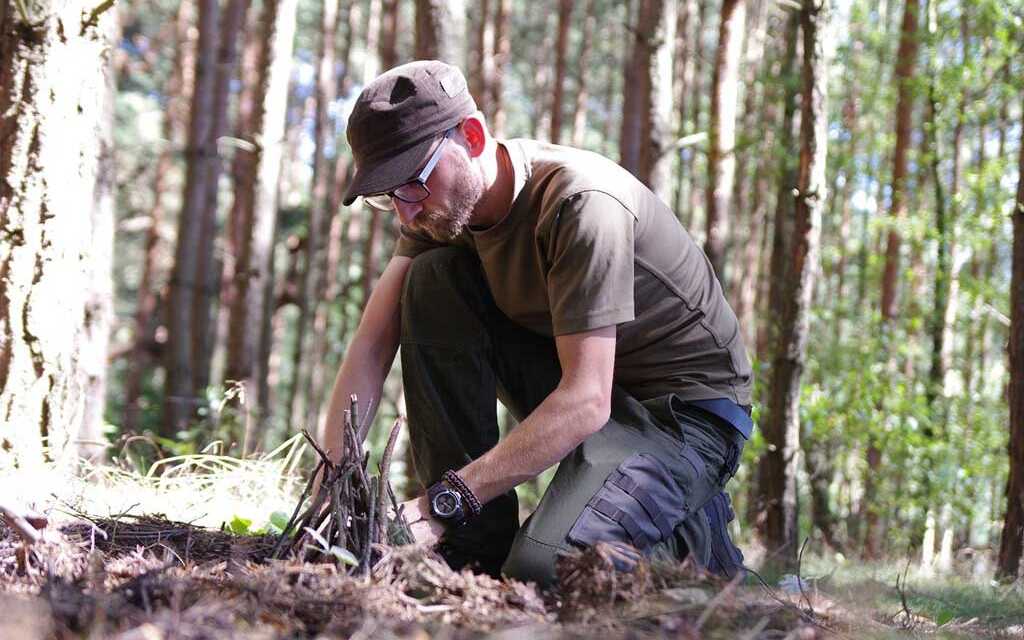
Wilderness survival is a very challenging, yet amazing experience. You may be in such a situation for pleasure or you may be unexpectedly stuck in the wilderness. In all cases, this guide will be of great help to you.
Let’s discover the top skills, tricks, and tips you should know to stay safe and avoid panicking.
1. Find clean water
That’s the first thing you have to think about. Indeed, A person can die from dehydration in just a couple of days, and before that, he can start feeling unconscious when reaching less than 10% of dehydration.
Finding clean and uncontaminated water is possible with these tips:
- If it’s raining or if you predict that It’s going to rain, be prepared to collect and store as much water as possible. You can use containers, otherwise, try to find natural objects around you that can serve as storage tools, probably with a little bit of transformation.
- If it’s snowing or if the ground is covered with snow, collect enough quantity and melt it with a fire or by exposing it to the sunlight. You can even use your body heat by stuffing some snow in a water bottle and putting it in your coat.
- Eating snow without melting it requires more calories for digestion. So, pay attention to not wasting your energy.
- Dig for water near plants, because vegetation may be a strong indication that water is available underground.
- Look for streams and rivers. This would be easy if you are equipped with a map.
- You may extract water from some species of vegetation by squeezing them or cutting them with a knife.
Keep in mind that water should be decontaminated of any pathogens. You can boil it for a minute before drinking it. It’s a dangerous situation to get sick in the wilderness.
2. Build a shelter
Building an effective shelter is crucial in the wilderness. It can be made with different options according to your needs like protecting yourself from cold, wind, rain, predators, sunlight, …
The best and easiest way is to find a premade shelter like a rock shelter, a small cave, a hollow tree, or any sufficiently big tree that can serve as a good starting point to make a shelter quickly.
It’s also quite easy to build a shelter from scratch. Look for objects like branches that may help you mount the framework. Use big and solid materials to be more protected.
After finishing with the basic structure, stack progressively smaller sticks and big leaves to fill in gaps and increase the insulation.
Don’t bother yourself with the design and think small to get things done easily.
3. Make a fire
Starting a fire when you don’t have a lighter is something that many people ignore.
It’s an important survival skill to learn because fire can be used to:
- Decontaminate water.
- Cook food.
- Signal rescuers.
- Generate warmth.
- Provide light.
- Protect you from predators.
There are different ways to start a fire. It’s safer and more convenient to master more than one method. Start by collecting enough quantity of dry sticks, leaves, and branches.
If you have some tools like a lighter, matches, magnesium fire starter, … the task will be much easier.
It’s also possible to use a battery removed from your vehicle or boat to create a spark and light a dry tinder.
There are many other primitive methods like cord drill, hand drill, mouth drill, log drill. You can learn more about these skills by watching YouTube videos.
Create a campfire reflector from piled up rocks and place it behind the fire. This will push more heat in your direction.
Sit between the fire and the back of your shelter. Keep your stuff away from fire because small embers can be easily picked up by wind.
4. Food
You may be surprised that food is not the first priority to consider, because humans can stay alive more than one week, especially if there’s access to an adequate water intake.
The available menu in the wilderness is quite sufficient and may vary according to the season and the environment.
It’s recommended to mix vegetal and animal sources of food to have a balanced diet.
For vegetal sources, you should be able to identify edible plants and avoid toxic species. This is not an easy task, because you may confuse safe and deadly plants.
If you are uncertain, limit yourself to the most known and safe plants like asparagus, elderberry, nettle, wild raspberry, dandelion, curled dock, lamb’s quarters, and miner’s lettuce.
It’s recommended to avoid mushrooms and fungi, because many species are toxic.
5. Hunting, fishing, and trapping
Animal-based foods tend to be good sources of complete proteins, but are also difficult to get in the wilderness. For this reason, it’s time to learn and try hunting, fishing, and trapping.
Start with simple tasks like:
- Throwing sticks.
- Creating a bow and arrows, practicing with shooting arrows.
- Trapping with basic tools and skills. Do avoid traps that may torture preys. For example, instead of making a deadfall trap with a rock, you can make it with a hollow trunk or a convex container.
- Fishing with primitive tactics and tools like spearfishing.
Animal-based foods need more processing and cooking before eating. You already know how to start a fire. So, it will be a simple task to do. However, the smell of meat can attract carnivores.
6. Signaling for help
If you are stuck in the wilderness and want to get out of it. You need to try out some tactics to attract rescuers’ attention or any random people passing by near you driving cars or flying in planes.
Here are some simple, yet effective ways to draw attention:
- Light a giant fire so that it can be visible from far away. Hopefully, the ascending smoke can also be noticed during the day.
- Place stones on the ground in a way to communicate a distress message like HELP, S.O.S., …
- Use colored clothing as flags and put them in prominent places.
- Send lights by using specific devices like torches if you have, or use any shiny and metallic object like mirrors, glowing stones, …
Planes and helicopters are the most widely used means of transport when it comes to finding lost people in the wilderness. So, make sure to attract their attention when they come to your help.